



If you’re reading this article, chances are you’ve successfully avoided engaging with any crypto-related content to this point—which, congrats, that’s an achievement. Or maybe you’ve started to dip a toe into the crypto world, but you were left more confused than when you started. Whatever brings you here, first things first: Welcome! (Or you could say “GM,” which means good morning in crypto-speak and functions as a general salutation.)


Like it or not, crypto is here to stay. The same technology that enables cryptocurrencies like Bitcoin and Ethereum is what powers NFTs, or non-fungible tokens, which can be bought and sold using cryptocurrency. When an artist named Beeple sold one for $69 million last March at Christie’s, and you may have asked yourself, “But isn’t it just a picture?”
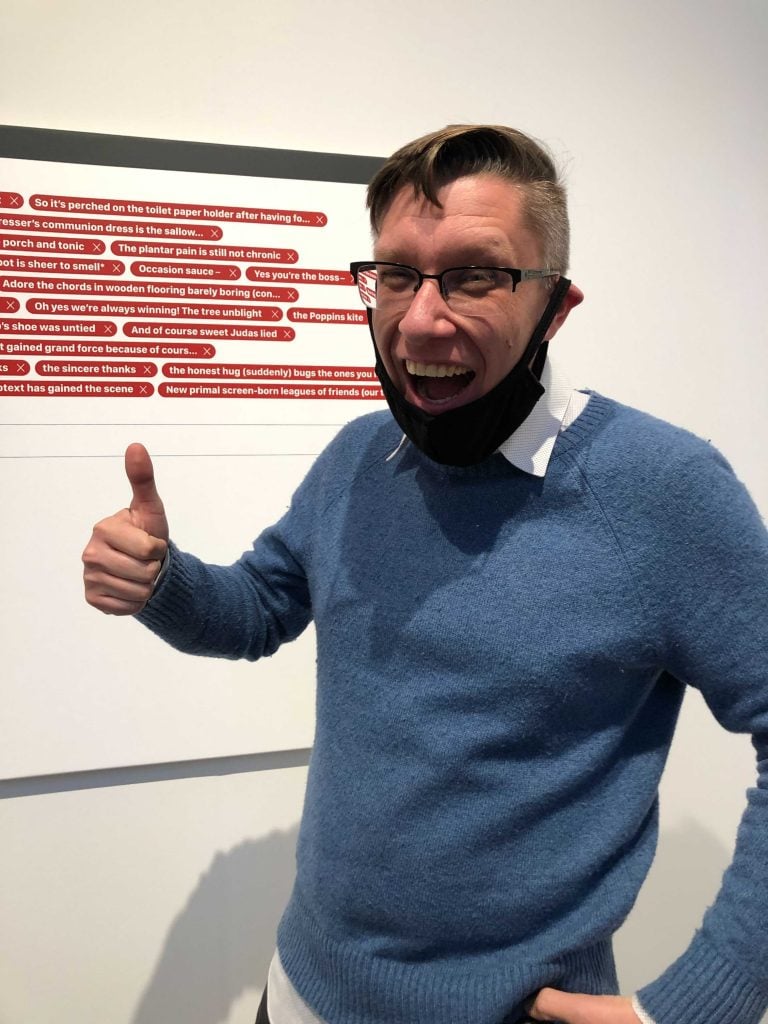
It’s Beeple! He’s also known as Mike Winkelmann. Photo: Katya Kazakina.
By now, you’re probably aware that NFTs are not just jpegs (and a mint is not just what you eat after a meal). To put it simply, NFTs are a type of digital asset. The image attached to them is less important than the underlying code, or smart contract. The smart contract is what gives the NFT utility. In some cases, that utility is just proof of ownership of the image; in others, it can act as a membership pass to a community. All of this data is stored on the blockchain, which serves as a record of all transactions. NFTs can be minted on different blockchains (such as Ethereum, Solana, or Flow), and because of the way transactions are verified, blockchains are secure. It’s helpful to have a general familiarity with some of the technical concepts, but don’t worry too much about understanding how they work.
In any case, NFTs have taken the art world by storm. The overall market for NFTs ballooned to more than $17 billion in 2021, Damien Hirst and Tom Sachs have launched NFT projects, and besides auction houses, galleries like Pace, Jack Hanley, and Galerie Koenig…