



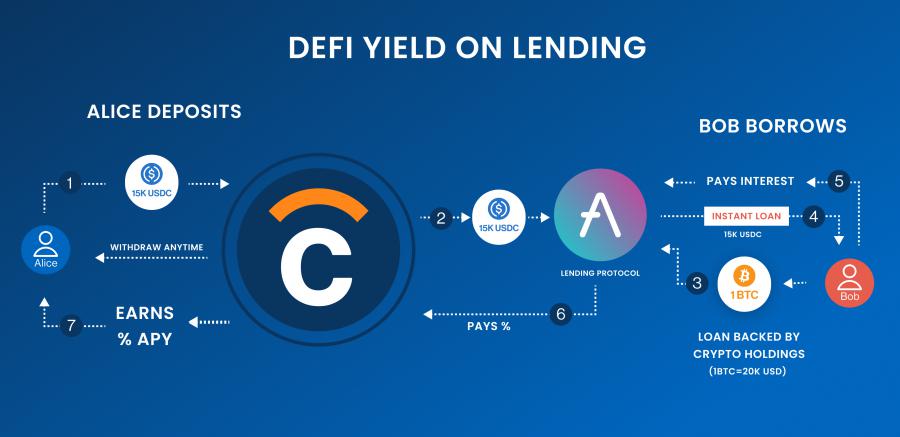

defi yield on landing


cefi yield on landing
TORONTO, ONTARIO, CANADA, November 30, 2022 /EINPresswire.com/ — To understand how Coinchange’s Yield is different from most other Yield providers, let’s consider two examples of yield generation; in the first example we will consider DeFi Yield generation (Coinchange’s Area of Expertise) and in the second example we will consider CeFi Yield generation (such as the ones used by many who are blowing up currently)
Here is how DeFi Yield generation on Lending works:
Let’s say Alice, a Coinchange user, deposits (1) 15,000 USDC on our platform and Coinchange deposits the USDC in a DeFi Lending Protocol (2).
Since this DeFi Lending Protocol uses collateralized lending, if Bob wants to borrow our USDC, he needs to post a collateral (3) that’s worth more than $15,000.
So let’s say he deposits 1 BTC worth $20,000 and borrows our 15,000 USDC (4) . He is now paying us interest (5) on this borrowed USDC which is how Alice earns yield on her USDC (7).
If the liquidation threshold price of his collateral is $18,000 and if the price drops to this value, the protocol will automatically sell Bob’s BTC (if he doesn’t post any more collateral or repay his debt) and return Alice’s USDC worth $15,000.
Thus if Bob defaults on his loan, the protocol’s liquidator liquidates his collateral automatically since all loan positions are transparent and on-chain, and Alice gets her money back.
This is an overly simplified example with many assumptions. In reality the strategies used by Coinchgange are sophisticated, complex and use state of the art collateral management but the basic principles are the same.
Here’s how CeFi Yield generation works:
Let’s say Alice, a ClockFi user, deposits 15,000 USDC on their platform (1).
ClockFi will lend (2) her deposits to a trader, market maker or a hedge fund and the contract will be signed off-chain.
This loan could be collateralized or…