




Southwest Economy, Second Quarter 2022



Cryptocurrencies have existed for over 10 years. Since their launch, cryptocurrencies have grown in quantity and market capitalization. Because they rely on decentralized technology that is computationally complex, cryptocurrencies are significant energy consumers. Texas’ power-generating abilities have captured the attention of cryptocurrencies as miners move to the state.
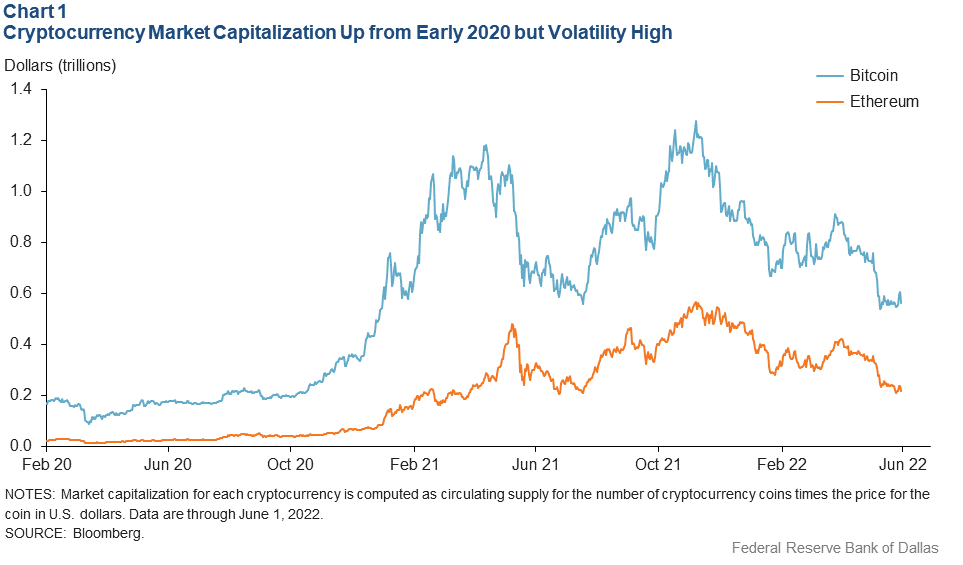
Cryptocurrencies have been around over a decade, with their valuations rising notably, though not always steadily. Cryptocurrencies are a form of digital currency that can serve as a medium of exchange and a store of value, although they lack the backing of any central authority or government.
The market capitalization of bitcoin and ethereum—the two largest cryptocurrencies—totaled about $781 billion as of June 1 (Chart 1). All told, there are about 100 significant cryptocurrencies, with a market capitalization of approximately $1.2 trillion, down 60 percent from their recent peak in fall 2021.
Cryptocurrency mining refers to the work (done by computers) that manages the blockchain, the record of cryptocurrency transactions. Crypto mining is controversial, in part, because the process requires large quantities of electricity, which is often produced using fossil fuels such as natural gas or coal. Moreover, crypto mining is growing quickly in the U.S. and in Texas, following recent adverse regulatory and political developments in foreign centers of crypto mining activity—China, Russia and Kazakhstan.[1]
Mining activity is measured by hash rate—a metric of the computational power needed for calculations to maintain the blockchain and earn new cryptocurrency coins. The bitcoin…