






Its been less than six months since China’s May 2021 crackdown on bitcoin mining, resulting in the greatest shakeup in the network’s history.
According to Cambridge University’s Center for Alternative Finance (CFAF), since May, the US has pulled into first place for bitcoin mining with 35% of the global hashrate, while China has gone from 45% to zero.
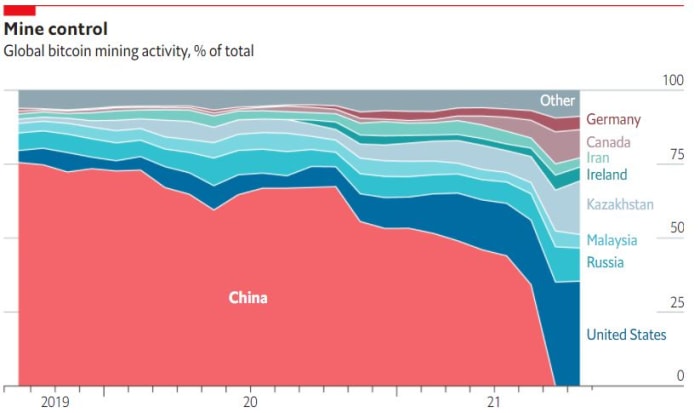
Although Kazakhstan is currently in second place with 18% of the network’s mining, the small country is running out of energy and has asked that the mining sector reduce their consumption to a total of 100MW, giving each farm 1MW over two years.`
That leaves Russia coming up fast with 11% of the network’s hashing, up from 7%, and likely to bypass Kazakhstan at some point as its northern region of Siberia has abundant amounts of stranded hydroelectric power, much like the now abandoned mining area of Xinjiang, China.
Why Russia Is A Natural Mining Destination
When it comes to proof of work mining, there’s nowhere better suited than Russia’s Siberia Irkutsk region, where most mining in Russia takes place. Its abundance of stranded hydroelectric power (estimates are only 20% is used now) makes it a destination of choice for environmentally conscious miners.
- The climate couldn’t be more ideal — cooling large numbers of ASICs is a growing challenge for the industry with bigger ops looking at immersion cooling to compensate for the heat generated by running so many computers in one place.
- Large quantities of stranded energy, mostly hydroelectric dams are going unused and leftover from the Soviet Union’s industrialization drive in the 1920s. They’re still producing energy but there’s no market close enough to benefit.
- The Russian government has welcomed miners despite their prohibition on bitcoin as a currency.
Bitriver Mining
In a recent release, bitcoin miner Bitriver, headquartered in Zug, Switzerland, with offices in Moscow, who is currently mining in the Irkutsk region of Siberia,…