




Guest post delivered by Stobox.


The asset tokenization industry is currently experiencing strong growth. More tokenization-related organizations are emerging, and more and more projects are raising millions of dollars during STOs. Just a quick fact: the global tokenization market size was USD 2.3 billion in 2021 and it is predicted growth is up to USD 5.6 billion by 2026.
At the moment, one of the most suitable regions for holding a security token offering is Europe. Local authorities are seeking to build a favourable policy regarding the STO regulation. Many popular tokenization-related projects also come from Europe. Stobox, an award-winning company that provides consultation services in the field of asset tokenization, analyzes the STO market in Europe, its regulation, and prospects in this article.
Current tokenization market in Europe
STOs in Europe are developing quite quickly. In total, over the past 3 years, from 2017 to 2020, the number of tokenized assets has grown several hundred times. This trend will continue in the future. According to PlutoNeo and Tangany’s research, Europe is set to see an STO boom in the next five years, with a total market volume of more than €918 billion by 2026. Regarding the future growth of security tokens, it is estimated that the growth rate will be roughly 81% each year from 2021 to 2026.
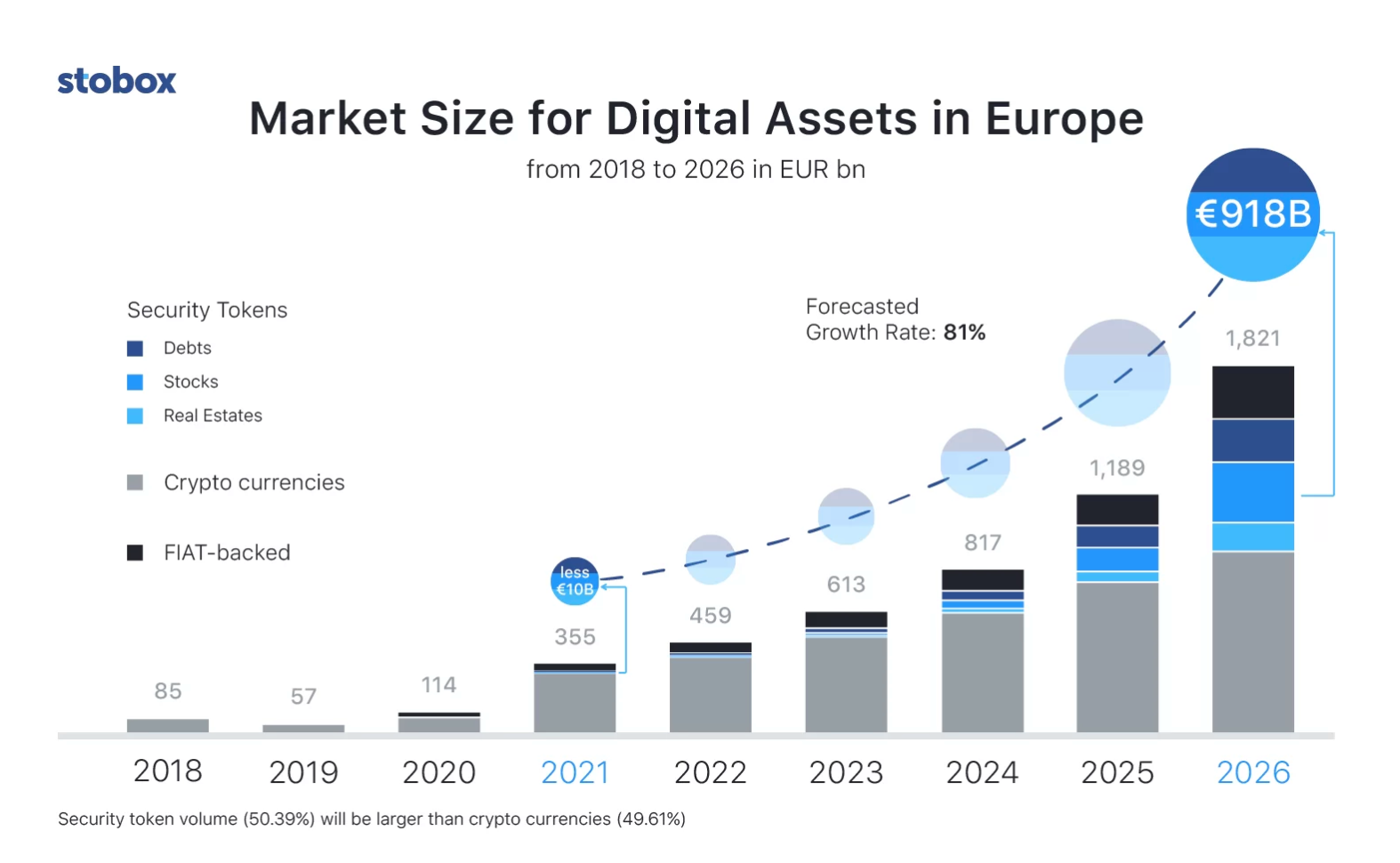
This trend is explained by the growing interest in cryptocurrencies and tokenized assets, which offer high liquidity and a way to save and increase funds for investors of any scale.
Regulation of STO in Europe
With the growing popularity of cryptocurrencies, ICOs, and STOs, European authorities decided to create unified regulatory rules for a new financial instrument and harmoniously fit them into the existing principles of the economy. This process was launched in 2020 and resulted in financial licenses for digital asset custody in EU countries such as Germany.
Although the rules vary from country to country, in general, the…