






Boston has its first one ever at the Pellas Gallery.
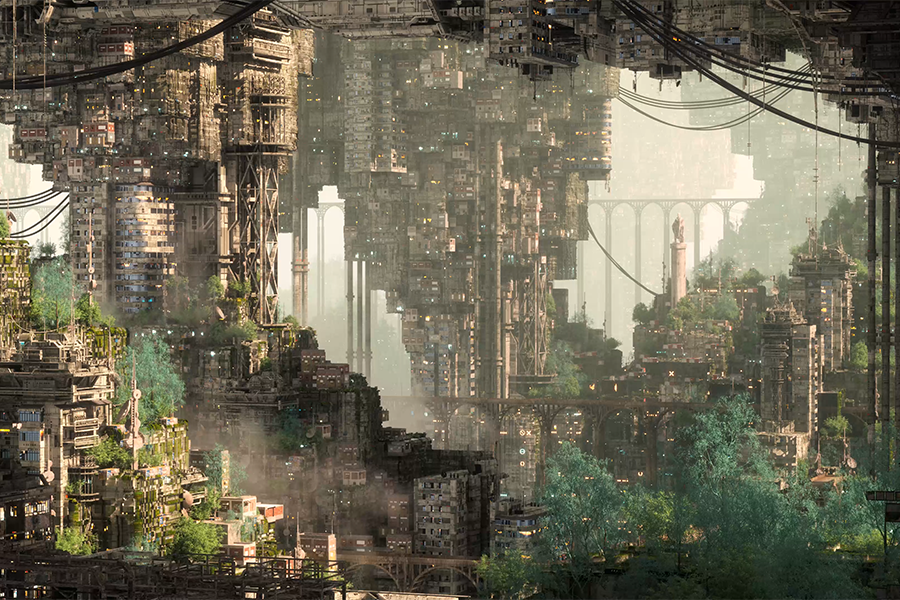
The Cycle by Annibale Siconolfi
By now, most people have heard of NFTs, or non-fungible-tokens, even if they have no idea what they are. As a confirmed Luddite, I fell into that category myself, although I had read accounts of obscene amounts of money being spent on them. But they seemed like little more than the latest buzzword in the art world, and a baffling craze among collectors, something befuddlingly tech-related and incomprehensible.
Then I received an invitation to attend the opening of “New Horizons,” Boston’s first NFT exhibit, at the Pellas Gallery on Newbury Street (running through April 23). Consulting Wikipedia, I learned that an NFT represents a unique work of art but is physically nothing more than a digital certificate of authenticity stored on block-chain. They’re the creative equivalent of crypto-currency (with which they share common DNA, and with which they’re most often purchased). It’s precisely this intangibility that confounds those of us who are used to thinking of art as simply something that hangs on a wall. In what world is a digitally stored unit of data the equivalent of a Rembrandt, or even dogs playing poker? My initial reaction was “WTF?”
However, I’m not one to miss a gallery opening (pronounced “free wine”), and I resolved to go, although you could practically hear the eyes rolling into the back of my head. What would I be looking at— computers mounted on a wall? Code scrawling across a screen? How do you display something that exists only in the ether? How do you create a gallery show out of something so abstract as to be literally conceptual?
The answer, it turns out, is not that far from the traditional mode of displaying art, except that in subtle but significant ways, NFTs are…